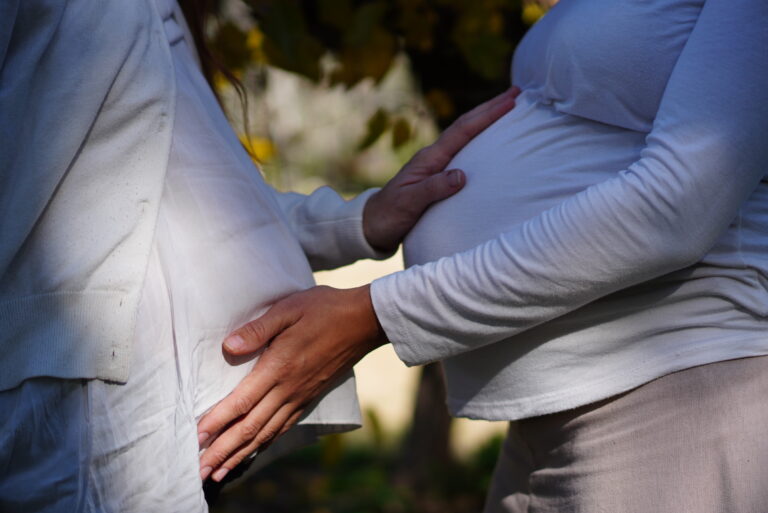



Pregnancy is a new stage that marks a before and after in a woman’s life. It is a deeply symbolic stage, where both your identity, the relationships you have, and the way you envision your future begin to change. And this, despite being an experience you wholeheartedly sought and is socially idealized, can lead you to go through moments of sadness, anxiety, or fear.
And no, this doesn’t mean that you are ungrateful, it doesn’t mean ingratitude, lack of love, or that “you must be doing something wrong.” It’s a very important stage in your life, and your mind is responding to a huge life change. Your emotions are not a flaw; they are the human imprint of a massive process you are going through. This doesn’t diminish you, nor does it define you negatively: it simply confirms that you are alive, sensitive, and transforming. It simply means that you are human.
Ambivalent emotions: a natural language of the unconscious
From bioneuroemotion®, everything is information; emotions are too. Every emotion we feel – whether pleasant or uncomfortable – arises because it serves an adaptive function in response to the change happening in your body and the change that will occur in your life with the arrival of the new being.
Pregnancy can activate biological memories related to:
- Changes in your role: “I stop being myself to become a mother.” And this can be dizzying.
- Changes in your emotional security: Will I be ready? Will I do it well? Will I be a good mother? Will I be able to handle this? Questions that come from sincerity, from the innocence inherent in vulnerability.
- Changes in your relationships: shifts in your connection with your partner, with your family, awakening memories—conscious or unconscious—about how you were received, cared for, or supported.
- Emotional survival: fear of the unknown, of the uncertainty of this new situation, of the major change approaching, or of losing part of the life you knew before this change.
Therefore, feeling this ambivalence—mixing desire, hope, anxiety, or sadness—is not a contradiction; it is a natural response to a profound transition. It does not reflect your ability to be a mother, but rather your human capacity to adapt to new experiences and navigate uncertainty.
Why can you feel sadness or anxiety even if you wanted to?
A wanted pregnancy and uncomfortable emotions are not mutually exclusive. In fact, they often coexist. Some reasons we frequently see in consultations are:
- Grieving for your previous life is triggered
Even though pregnancy is a reason for joy, your unconscious senses that something is changing forever. And with every change, a small grief arises. - Family memories arise
Pregnancy connects with transgenerational stories about motherhood, loss, expectations, or female roles. Sometimes, without realizing it, we carry emotions that aren’t entirely our own. - The fear of not measuring up appears
Culture demands that motherhood be perfect and happy. That pressure creates anxiety, and it is common for a woman to feel guilty for not fitting into that ideal. - Hormonal changes + life changes
Hormones affect us, of course. But emotions are a complex mix of biology, personal history, and emotional context. - The unconscious reorganizes itself
Bringing a life into the world is, symbolically, an act of creation. The unconscious rearranges meanings, beliefs, and boundaries. That reorganization is sometimes felt as anxiety.
It’s not about always being happy, but about allowing yourself to feel whatever comes up
Emotional well-being during pregnancy does not depend on avoiding uncomfortable emotions, but on giving them a safe space to be expressed.
Bioneuroemotion® suggests observing these emotions without judgment, understanding their origin, and transforming them through awareness.
Allowing ambivalence is an act of emotional maturity and also of self-love.
How can emotional support help you?
A support process through bioneuroemotion® helps you to:
- Understand which personal story is activated during your pregnancy.
- Free yourself from guilt and family mandates.
- Learn to experience your emotions without fear.
- Reorganize your inner world to live motherhood with greater calm and awareness.
If you are experiencing your pregnancy with mixed emotions, you don’t have to go through it alone.
I invite you to a free informational session, where you can learn how emotional support can help you navigate this stage with more clarity, support, and well-being.